
By Katie Kerwin McCrimmon
Despite vehement opposition from prosecutors and sheriffs, a bill that would reduce possession of small amounts of drugs from felony offenses to misdemeanors advanced in the Colorado legislature this week.
Denver District Attorney Mitch Morrissey told members of the Senate Finance Committee on Tuesday that SB12-163 would destroy Denver’s drug court and undermine his ability to entice addicts into drug treatment because he could no longer threaten them with felonies.
A representative for Colorado sheriffs also questioned the costs of the bill. The fiscal note predicts that it will save the state nearly $1 million next year and $2.2 million the year after that. Backers contend that fewer people would wind up in courts and in prison, thus saving the state money. Savings from the bipartisan measure must be spent on drug treatment programs. But, county officials say the cost of dealing with a flood of drug cases would merely shift from state courts and prisons to county courts and jails, where misdemeanor cases are handled. Lawmakers supported an amendment Tuesday aimed at preserving Denver’s Drug Court and analysts will now revise the bill’s fiscal note, so cost estimates could change.
Regardless of the amendment, Morrissey opposes the bill. He said people caught with drugs almost never go to prison on the first or second offense. He said the system isn’t broken.
“I don’t know what you’re trying to fix,” he said.
He said addicts commit 60 to 100 crimes a year to feed their habits and predicted that crime and drug use will go up if the bill passes. Furthermore, he said drug dealers would use the bill to safely carry small amounts of drugs from their supply caches to customers.
“These guys got you guys figured out,” Morrissey said.
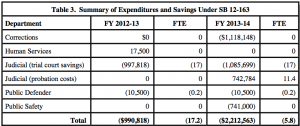
Estimated state savings for reducing drug possession from a felony to a misdemeanor. County officials say the bill merely shifts costs to local courts and jails where misdemeanor cases are handled. A revised fiscal note is expected in about a week. Click on image to enlarge.
He implied that lawmakers were naïve, saying their estimates for amounts of drugs that constituted personal use were way off.
“If there is a person out in Civic Center Park now with four grams of crack or heroin or two grams of meth, they are distributing those narcotics. The use amount is far, far less than those amounts you’re talking about. That’s the reality. You can change these numbers however you want. These guys will still carry the amount that gives them the lowest (criminal penalty).”
Advocates for the bill, however, said Morrissey and others are simply wrong in thinking that threats work with drug addicts.
“The truth is there is no research that says (we should) make the stick bigger than it needs to be,” said Maureen Cain, a criminal defense attorney and legislative policy director for the Colorado Criminal Defense Bar.
An unconventional mix of advocates including liberal Democrats and libertarians from the conservative Independence Institute have been working for the last couple of years to alter Colorado’s drug policies.
Cain said Colorado is among the top six states for drug use in the country while being among the bottom six nationally in funding drug treatment.
She said the move to make more and more crimes felonies has simply boosted prison populations without solving the real problem of addiction.
“We’ve just created a society of felons,” Cain said.
A bipartisan coalition of lawmakers is sponsoring a bill to reduce drug possession from a felony to a misdemeanor in Colorado.
Sen. Pat Steadman, D-Denver, one of the co-sponsors of the bill, said the measure focuses strictly on possession, not on drug dealers.
“What this bill tries to do is chip away at the customers of that man (in Civic Center Park) who is trying to peddle drugs,” Steadman said.
“There’s a lot you can say about the war on drugs,” Steadman said. “We’ve also declared a war on young men of color, the mentally ill and victims of trauma. Rather than waging that same old war, we’re trying to wage a war on addiction.”