Archive | November, 2012

HIV cases down, risky behavior up

HIV cases down, risky behavior up

By Katie Kerwin McCrimmon

AIDS killed scores of David Lipson’s close friends, an adored partner and even his own brother.

One of the first men in the nation to be tested for HIV back in 1984, David Lipson received the same terrible test results that ensnared so many of his friends. Then 26 and living in Los Angeles, Lipson learned he was HIV positive and his doctor told him he would die within two years.

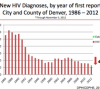
HIV infection rates are down 45 percent in Denver from 2005. Rates could decrease further if more men engaged in safe sex. Source: Dr. Mark Thrun, Denver Health. (Click on image to enlarge.)

Instead of succumbing to death, the stubbornly positive Lipson made a conscious decision to live. Once a performer with the infectiously optimistic motivational entertainment group, Up With People, Lipson embraced positive people, a healthy diet and lifestyle, and extracted every ounce of joy from his life.

Today, the Denver native, former professional drummer and record label owner is like an ambassador from another era when AIDS emerged as a modern plague that killed all in its path, especially young gay men like Lipson.

Now, 54, alive and well against all odds, Lipson works for Denver Health and helps with outreach programs to prevent new HIV infection. On the one hand, the news is good. After reaching a peak in 1987 of 624 new cases, Denver will finish this year with far fewer new reports of HIV infection: about 133 for 2012.

Told he was going to die when he contracted HIV in the 1980s, David Lipson chose to live. Lipson, rowing in the right front of a raft, enjoyed a recent family reunion in Glenwood Springs. Lipson now works at Denver Health where he tries to reduce new cases of HIV infection.

At the same time, Lipson and Dr. Mark Thrun, director of HIV and STD prevention for Denver Health, have seen a new blasé attitude among young people about safe sex.

For instance, Thrun said that the number of men who reported having risky anal sex with another man without condoms has nearly doubled since 2005. In that year, about 25 percent of men said they received anal sex without a condom during a casual encounter. The number jumped to more than 46 percent in 2011. Men who have sex with men and men who are either African American or Latino account for the majority of new HIV cases in Colorado.

Lipson said there’s a bizarre trend among young men here who think it’s “hot” to have sex with a man who is already HIV-positive.

“There are many people who forgot or don’t know what it was like back in the day,” he said. “There were so many lives sacrificed. People today don’t get that. They don’t see that. Some young people want to have unsafe sex.”

As people around the globe commemorate World AIDS Day on Dec. 1, Lipson wants young people to know the importance of getting tested, that we are enormously lucky that HIV is no longer a death sentence and that many people suffered before HIV became a manageable chronic condition instead of a horrifying slow-motion killer.

Lipson said he is the only survivor among his close circle of friends from the 1980s.

Like an ambassador from another era, David Lipson remembers when AIDS was a plague that killed all in its path, especially young gay men like him. His brother and at least 30 people in his close circle died of AIDS and he knew at least 100 people who lost their lives to the disease.

“All of our friends were dying off in hospitals. There would be two and three floors full of people dying,” he said.

His older brother died in 1993 after enduring torturous AIDS-related illnesses, including painful welts on his face. Lipson’s partner, Wayne, died in 1994. The two were able to take dream trips to Venice, Paris and London, but Lipson then had to watch as his partner’s brain deteriorated before his death.

“It’s a lot of loss,” he said. “It was a dark, dark period in my life.”

When asked why he, alone, survived, Lipson focuses on his choices.

“I made the decision to live every day and find joy and humor. It’s important to laugh every day and be in good relationships,” he said. “I decided I was not going to live in the disease. I called it a healthy denial. I’ll go to the doctors. I’ll do my blood work. I’ll live a healthy life.

“My basic thing is that I love everyone. I think being kind and loving to everyone is essential, not having discord in your life, making your life joyful, getting excited over little things.”

Dr. Mark Thrun, director of HIV and STD prevention and control for Denver Health, says testing and treatment have cut new cases of HIV infection. But he says some young gay men are putting themselves at risk by engaging in unsafe sex.

Lipson remembers being very afraid to get tested. He believes he may have been infected with HIV as long ago as 1980. There was no test until 1984. For a while, he put off getting the test, but became so ill with nausea and flu-like symptoms that he finally went to see a doctor. The results came back. The good news: he felt terrible because he had giardia, an intestinal parasite. The bad news: he had HIV.

One of Lipson’s missions is to urge people to get tested even if they’re afraid of the results, like he was.

“I would like to work toward getting rid of the stigma that people have to fear HIV. There are millions of people who won’t get tested,” he said.

Yet, there is more to fear in not knowing.

“Our medical people are amazing. I want people to test, then if they’re positive, get treatment. This is something we can live with.”

Dr. Thrun said public health experts are getting better both at treating HIV and targeting people who should be tested.

Home tests are now available over the counter at Walgreens for just $49. That’s still a high price for many young and low-income people, but a simple saliva swab gives a result like a pregnancy test in just 20 minutes.

Thrum said more doctors are beginning to recommend that all adults get tested for HIV. And people in high-risk groups need to be tested at least once a year.

“The revolutionary changes in medicine came in 1995 and ’96,” Thrun said. “Over the past half-dozen years, we’ve tried to be more thoughtful about HIV prevention. We’ve really tried to target those people who are at greatest risk: gay men, blacks and Latinos.”

In Colorado, 84 percent of new HIV infections emerge among men.

Home tests are now available to detect HIV infection.

Public health workers sometimes offer testing where young men are: in bars, in private or in easy-to-access clinics, for instance.

“Once people get tested, we make sure they get into care, stay in their care, get on meds and stay on meds,” Thrun said.

“We’ve been very intentional about focusing our efforts and it has worked,” Thrun said. “We won’t see HIV go away completely. We’ve still got a ways to go.”

But, said Thrun, testing, prevention and continual education about safer sex can change behavior and

Posted in Featured, News, Public Health Issues, Trends In Health Care0 Comments

Colorado’s health exchange must pay for itself by 2015

Colorado’s health exchange must pay for itself by 2015

By Katie Kerwin McCrimmon

While some states are still wrestling over whether to build their own health exchanges, Colorado is playing hurry-up offense, tackling major policy decisions including the biggest one on the horizon: how to pay for the online health insurance marketplace.

Now a reality across the country as the Affordable Care Act steams toward full implementation, health exchanges are supposed to make it easier for individuals and small business owners to choose and buy health insurance plans. Some people will qualify for government subsidies to help them afford insurance while exchanges will funnel others into public health insurance options including Medicaid, Medicare and CHP for children.

Colorado’s exchange — which will soon have a new name — is slated to open for enrollment in October of next year with coverage that will start on Jan. 1, 2014.

By Jan. 1, 2015, Colorado’s health exchange must be financially self-sustaining.

So far, Colorado has received two federal grants totaling $62 million that are funding the planning, technology design and start-up costs for the exchange. Federal taxes will also fund the first year of operations. Then, Colorado and other states must find ways to pay for the exchanges themselves.

The board creating Colorado’s exchange will tackle financial sustainability in meetings next month. Estimates in other states point toward annual operating costs that could exceed $50 million. Other states are considering user fees, sin taxes or ad sales to pay for exchange operations. A consulting firm is preparing cost projections for Colorado and will report to the board on possible sources of revenue. The challenge of paying for the exchange will be considerable since health insurance costs have already been climbing to unaffordable levels.

Other questions, both big and small, also loom.

Somes states will run their own exchanges while others will defer to the federal government. Eleven states have yet to decide. Source: Kaiser Family Foundation, www.statehealthfacts.org

What should the exchange be called? How will a network of “navigators” across Colorado be able to meet with people face-to-face to help them figure out which insurance plans to buy? Will they work for the exchange or for existing community-based health entities? What’s the best way to entice as many insurance carriers as possible to take the risk of selling their plans during the first critical year? Who will seek to buy health insurance in the first year? Will extremely sick individuals skew prices if, as anticipated, they are the first to line up for health insurance? And, will Colorado benefit by operating its own exchange?

As of mid-November, 17 others states and Colorado are building their own health exchanges while 16 others will default to a federal exchange. Six states are planning for partnership exchanges and 11 remain undecided. Many states waited anticipating that Gov. Mitt Romney might win the presidency in November and would follow through on vows to dismantle the Affordable Care Act. Instead, with President Obama’s victory, many states now find themselves staring down unrelenting deadlines to get moving.

Managers and exchange board members in Colorado say the state will benefit from having its own exchange because a Colorado-managed competitive marketplace should be better tailored to a state that is so geographically and economically diverse.

“We have always been building the exchange to meet the unique needs of Colorado,” said exchange Board Chair Gretchen Hammer, who is also executive director of the Colorado Coalition for the Medically Underserved. “We are much more confident in our ability to serve the diverse needs of Colorado, from people in rural and urban areas to individual consumers and commercial customers. We believe we’re better able to serve them with a Colorado exchange, with navigators trained by us.”

Hammer said Colorado has a relatively robust insurance marketplace with relatively strong competition, which is good for consumers. Board members want every decision they make to help foster vibrant competition and affordability for consumers. The biggest challenge in building the exchange is that there are so many uncertainties about the future.

Beth Soberg, president and CEO, Unitedhealthcare Colorado, and Steve ErkenBrack, president of Rocky Mountain Health Plans, debate whether insurance companies should face waiting periods if they opt out of selling on Colorado’s health exchange.

“The marketplace will be unknown. The rules of the market will change. Consumer and business behavior will change,” Hammer said. “We all feel the tensions of doing our best to make good decisions, but also doing that in a time of uncertainty with an inability to predict how things will turn out.”

For instance, during an exchange meeting on Monday, board members were trying to decide whether to penalize insurance companies that decided to sit out the first year of the exchange by barring them from joining for two more years. Some of the insurance company executives on the board said that while their companies would oppose waiting periods, they personally felt some sort of waiting period was essential to entice as many insurers as possible to sell products on the exchange. Ultimately, the board voted to mandate one-year waiting periods for insurers who opt out of the exchange.

Among the many other decisions the Colorado exchange mangers have made is to create a statewide system of customer service agents who will be known as “navigators.” Initially, the exchange was conceived as a Travelocity-style online site where consumers could peruse different health plans and buy them on the spot. But planners realize that buying health insurance is much more complex than buying a plane ticket. So, they will have web-based help, a call center and in-person navigators who can help consumers pick the right options for them.

The exchange recently hired Adela Flores-Brennan, a well-known Denver health care attorney who used to work at the Colorado Center on Law and Policy. Flores-Brennan is now beginning to design a network of navigators who may or may not be direct employees of the health exchange.

“If you want to sit down face-to-face with someone, there will be a continuity of support to allow that,” said health exchange Executive Director Patty Fontneau.

She said it’s still unclear exactly how the navigator network will function.

“We’re seeing who’s out there already doing this type of work,” Fontneau said. She said Colorado is not unique in planning for a vast system of in-person navigators. Ultimately she suspects all states will opt for in-person help.

“It’s helping someone with what is truly a very complex process. I think navigators are absolutely critical,” Fontneau said.

Another decision on deck is picking a better name than the Colorado Health Benefits Exchange. While not critical in terms of policy heft, a new name could make the exchange more inviting and comprehensible to consumers.

“We just started getting ideas,” Fontneau said. “We will get public input. It’s not something we will do behind closed doors.”

Back when Gov. John Hickenlooper picked the members of the health exchange board, concerns arose that the board had tipped too far toward industry with five of the nine board members having ties to health insurance companies or for-profit health care businesses.

Hammer said that the policy work has been complex but constructive.

“Working with the members of this board has been one of the most rewarding professional experiences I have ever had,” she said. “Whenever there has been a direct conflict (of interest) people have recused themselves from a vote.

“The diversity of our perspectives has been a strength. It has certainly made our conversations long, but Colorado is a diverse state and we needed all kinds of minds coming together.”


Posted in Featured, Legislation, News, Public Health Issues, Trends In Health Care0 Comments

Colorado tab for Medicaid expansion $858 million

Colorado tab for Medicaid expansion $858 million

By Katie Kerwin McCrimmon

Colorado would have to pay $858 million to expand Medicaid over the next 10 years, but authors of a new national study say states that participate will bring in billions in federal cash and will dramatically cut the number of uninsured.

If all states opt to expand Medicaid, the U.S. could cut the ranks of the uninsured by 21 million people or about 48 percent, the study authors found. They estimated that states would have to fund increases of about 3 percent in their Medicaid budgets or $76 billion nationwide while federal spending would increase by $952 billion or 26 percent.

The new study from the Kaiser Commission on Medicaid and the Uninsured and the Urban Institute increases cost estimates for Colorado’s Medicaid expansion over a similar analysis conducted two years ago. In 2010, their analysis estimated Colorado would spend about $470 million between 2014 and 2019 to cover low-income people who make up to 138 percent of poverty (about $15,000 a year for an individual).

The analysis estimates that Colorado’s share of paying for increased Medicaid coverage would be $858 million from 2013 to 2022. In Colorado, that would amount to an increase of about 3 percent. Federal taxes would fund about $10.3 billion for Medicaid expansion in Colorado, amounting to an increase of 31 percent in federal Medicaid spending over the next 10 years in Colorado.

The Affordable Care Act planned for the Medicaid expansion, but the U.S. Supreme Court ruled that states should be allowed to opt out. Governors and lawmakers across the country must begin deciding early next year whether to expand Medicaid. With intense focus on the “fiscal cliff” and potential cuts in federal spending, state leaders are nervous about committing to expanding Medicaid. They question whether Congress will be able to avert cuts now and deliver promised matching funds in future years.

The health reform law calls for the federal government to pick up 100 percent of the costs for Medicaid expansion from 2014 to 2016. States then would gradually pay higher portions of the cost, capping out at 10 percent.

Gov. John Hickenlooper has repeatedly said he’s concerned about unsustainable cost increases for health care and has declined to say whether he supports Medicaid expansion. His spokesman, Eric Brown, said Monday that the governor remains undecided.

“We have not made a decision yet and continue to gather information,” Brown said.

House Speaker Designee Mark Ferrandino, D-Denver, expects broad support from Democrats both in the House and the Senate to proceed with expansion. And he expects Hickenlooper eventually to join them in backing expansion.

“Given the amount that the federal government is picking up and how many more people we can cover, it’s something we have to consider moving forward with,” Ferrandino said.

While the cost estimates over the next 10 years are “not insignificant,” Ferrandino said the benefits could be great.

“What we’re getting for that increase is a huge benefit to the state,” he said, citing increases in the number of people who would have health insurance and an influx of federal cash.

Ferrandino said there are a “lot of moving parts” related to Medicaid expansion and he still wants to see much more detailed numbers from Colorado’s Medicaid managers, but he said the Kaiser estimates were within the range of what he was expecting.

Rep. Brian DelGrosso, R-Loveland, said that he’s unlikely to support Medicaid expansion, because the costs for Colorado would be too high and also because there’s no such thing as “free money” from the federal government.

“That money’s got to come from somewhere,” said DelGrosso, a member of the state’s powerful Joint Budget Committee. “It’s borrowed money. We don’t live in some kind of imaginary land where there’s just money that grows on trees. Whether it’s income taxes, sales taxes, and whether it’s federal or state money, there’s already a big tab for Medicaid.”

DelGrosso said it doesn’t really matter whether state lawmakers philosophically support or oppose expansion.

“It comes down to how are we going to pay for it?”

“(The Kaiser Foundation’s) number is close to a billion dollars. That’s a lot of money and by no stretch of the imagination does the state have a lot of extra money,” said DelGrosso.

As Colorado begins to recover from the sharp economic downturn, lawmakers face great pressure to increase funding for higher education and K-12 schools, he said.

“We’re basically competing for the same dollars,” he said. “Until we can identify how we’re going to pay for it, I don’t think it’s going to be prudent to go down that path (of Medicaid expansion),” DelGrosso said.

In Colorado, hospitals and health care providers stand to benefit greatly if fewer uninsured patients show up for care in ERs.

The report estimates that if all states expand Medicaid, they will save an estimated $18 billion on so-called “uncompensated care” for the uninsured. Colorado’s estimated share of those savings would be $277 million, according to the new Kaiser study.

The Colorado Hospital Association has been urging support for Medicaid expansion.

“We believe this report reinforces CHA’s position that Medicaid expansion is a worthwhile investment for Colorado to make, and that it would help reduce the cost shift and levels of uncompensated care statewide,” Julian Kesner, the CHA’s spokesman said in a written statement.

“However, until the State of Colorado releases its own estimates in terms of projected caseloads and costs under an ACA-related Medicaid expansion, the limitations of even the most respectable of third-party calculations should also be taken into consideration,” Kesner wrote.

He said it’s important to remember the context of the intense budget negotiations taking place now in Washington.

“We feel it’s critical to avoid any such outcomes in these negotiations that would hinder the ability to continue implementing the Affordable Care Act.”

The study authors predicted that states will face intense pressure to expand Medicaid because the federal dollars will be so generous.

“Overall, it’s hard to conclude anything other than that this is pretty attractive. It should be hard for states to walk away from this,” said John Holahan, director of the Health Policy Research Center at the Urban Institute and the primary author of the new analysis.

So far, governors in eight states have publicly stated that they won’t expand Medicaid. But Holahan predicts governors and lawmakers may reconsider those decisions either next year or in future years when they see what kind of federal money they could be leaving on the table.

“The economics of this are very strong in terms of adopting expansion. If for political reasons, states don’t want to do it, providers will put pressure on the states, Holahan said.

He and others said that states could change their minds about Medicaid expansion at any time.

“With the health exchanges, there’s a firm deadline for states to express their intentions,” said Alan Weil, executive director for the National Academy for State Health Policy.

Decisions about health exchanges are looming for many states right now. But, the Medicaid decisions are more complex and states can submit plans at any time, Weil said.

“We all expect this to play out over time,” he said.


Posted in Featured, Legislation, Public Health Issues0 Comments

Senator, doctor, champion for the vulnerable

Senator, doctor, champion for the vulnerable

By Katie Kerwin McCrimmon

The mother laces her fingers through her daughter’s hands, holding her in her lap. She sings to calm her while a medical assistant straps a blood pressure cuff around the girl’s arm.

Amy gets nervous going to the doctor. Countless strokes that she suffered in utero 18 years ago have left her blind and severely developmentally disabled.

At just over 100 pounds, she is petite, but still much too big for her mother’s lap. Even so, her mom, state Sen. Irene Aguilar, a primary care doctor herself and a Denver Democrat, knows well how to soothe Amy. Distressed, Amy cups a hand over her ears and repeats a phrase that sounds like: “Id-it. Id-it. Id-it. Id-it.” Aguilar hugs Amy and centers her again. In a quiet voice you might use to settle a tired toddler, she asks: “Do you want mommy to start?”

Amy decides to begin, belting out a line from the Hokey Pokey. “You put your right…”

“Foot,” Aguilar answers without missing a beat.

Then Amy calls out the next few words: “In. You put your…”

This type of call and response song is one of the primary ways Amy communicates. She has a special song for each member of her family, including her aunts and numerous cousins who help care for her. When she senses footsteps coming into the room, she calls out “Mommy” or “Daddy” and starts singing their special song. It may not seem like much. But when you consider that Amy and her identical twin sister, Meg, had a 50 percent chance of dying before birth, they both live up to their middle names. Amy’s is Milagro, Spanish for miracle. Meg’s is Hannah, meaning gracious gift from God.

A rare type of twins, known as MoMo (for monoamniotic, monochorionic) the girls shared the same amniotic sac. This type of pregnancy is very dangerous since the babies’ umbilical cords often become hopelessly entangled and can cause death or disability.

Sen. Irene Aguilar, the only practicing physician in the Colorado Legislature, takes her daughter Amy to visit her doctor, Andrea Fedele. Amy was born developmentally disabled and is about to turn 18. Aguilar needs a letter from the doctor stating that Amy needs a legal guardian.

At 18 weeks pregnant with a year-old son at home, Aguilar and her husband, Tom Bost, also a physician, learned about the scary complications they faced.

Their doctors offered a therapeutic abortion. But Aguilar and Bost decided they had been blessed with the medical skills and the finances to face whatever came their way.

Meg beat the odds. She is healthy and bright, an award-winning high school senior, poised to go to a top college, where she’s considering pre-med and a possible career with special needs children or Doctors without Borders. Amy faces a lifetime on Medicaid and forever will need extensive care and support. Amy and many of Aguilar’s neediest patients at Denver Health served as Aguilar’s inspiration when she suddenly jumped into politics in 2010 and was the underdog victor in a vacancy committee battle among six candidates to replace Sen. Chris Romer who resigned to run for Denver mayor.

The first in her immigrant family to make it to college, much less to medical school, and now the only practicing physician in the Colorado Legislature, Aguilar recently was elected to a new term and chosen by her peers as assistant majority leader of the Senate. She’s hoping to lead the Senate Health Committee.

Aguilar enters the 2013 session as one of the legislature’s most powerful voices on health issues, respected on both sides of the aisle and a leading Latina in the state. She plans to join Democratic colleagues in fighting to expand Medicaid to a greater share of the poor as planned in the Affordable Care Act, but undercut by the U.S. Supreme Court, which allowed states to opt out of expansion. Now governors and state lawmakers must decide how to handle Medicaid. Ultimately, Aguilar wants to ignite an even broader health revolution by bringing universal care to people throughout Colorado.

Undaunted by critics who say universal care is a pipe dream, Aguilar simply straps on her iPod and listens to one of her favorite tunes: “The Impossible Dream,” from the 1972 Don Quixote-inspired musical, “Man of La Mancha.” The lyrics spell out her determination: “To right the unrightable wrong….to reach the unreachable star….no matter how hopeless, no matter how far.”

Sen. Irene Aguilar kisses her daughter, Meg, goodbye on a Sunday morning before the election as she heads out to canvass door-to-door. Meg nominated her mom for the state Senate. Aguilar was the underdog victor in a race among six candidates to replace outgoing Sen. Chris Romer and has become a leading Latina in Colorado.

In Aguilar’s mind, true health reform is both fiscally conservative and socially just.

“I don’t think everybody should get every single thing in health care,” she said. “But we need to give everyone access to the great cost savings of basic health care and figure out how we can do that as a state.”

And someone needs to speak out for the vulnerable, Aguilar says.

“We need the safety net for people like Amy.”

Granddaughter of Mexican sharecroppers

Irene Aguilar’s grandparents grew up in Mexico, then moved to Texas to pick cotton.

“They would work on this farm owned by a big white landowner. They were basically sharecroppers. They had a little house with no plumbing,” said Irene’s sister, Fran Aguilar Walendzik, a registered nurse who also lives in Denver. “Had it not been for our culture, I don’t know that (Irene) would have become a doctor.”

Dr. Irene Aguilar examines Maria Monsivais-Dealderete, a patient of 20 years. Now 88, Monsivais-Dealderete misses Aguilar when she’s at the legislature. “She’s the best doctor. She’s so patient. She needs to be here,” Monsivais-Dealderete says.

“In the Latin culture, we would serve our men first. My mother would say, ‘get an education so you don’t have to be waiting on these people,’” Walendzik said.

Their mother made it through the fifth grade, their father to third. Aguilar is the youngest of four girls, raised in Chicago where her father worked at a plant that processed steel and aluminum. Aguilar won a steelworkers’ scholarship to attend college at Washington University in St. Louis. She finished in just three years, then went on to the University of Chicago’s Pritzker School of Medicine.

“Irene was always a determined child. When she sets her sights on something, she pretty much has to do it,” Walendzik says.

Take the pea soup incident, for example. One day when Aguilar was about 4 or 5, pea soup was on the lunch menu.

“I remember picking up Irene from daycare and the nuns didn’t know where she was,” Walendzik said. “It turned out she didn’t like the pea soup so she started walking home by herself.”

Later, it was no surprise that Aguilar would fight to get fair treatment for Amy at a private Montessori school that was happy to educate Meg and her older brother, Jonathan, but did not want to accommodate Amy.

“They wouldn’t touch her even with a full-time aide. I felt insulted for all children. That’s why I went into policy,” Aguilar said. “I learned so much from other parents.”

Dr. Aguilar gives her patient a hug as she leaves. Maria Monsivais-Dealderete has liver cancer, but had a good check-up.

Aguilar and Bost, who met while training together at the University of Colorado, found better educational options for their children, switching Jonathan and Meg to Colorado Academy and Amy to the Jefferson County Open School. She’s been in a fully inclusive program since kindergarten and will graduate in May.

Aguilar, meanwhile, became an activist.

She joined the Colorado Developmental Disabilities Council and later served on the vulnerable populations subcommittee for Colorado’s 208 Commission, an influential group that studied health care solutions and came up with many ideas later codified in the federal Affordable Care Act.

Bost has a nickname for his wife that reveals her tenacity. He dubbed her the “Mexican trekking monster” after one of their international mountain excursions to Nepal. Aguilar had heard about a legendary apple dessert high on the Annapurna circuit and fought her way up 4,000 vertical feet to taste it.

“When properly motivated, she can do almost anything, whether it’s health care reform or hiking for an apple pie,” said Bost.

Added her sister: “When she went into politics, I was a little surprised,” said Walendzik. “But if there’s anybody who could advocate on behalf of people and do it articulately, it would be Irene.”

Umbilical cords in a knot

Born eight weeks early on Nov. 30, 1994, the girls’ arrival revealed just how tenuous their survival had been.

As feared, their umbilical cords had twisted around each other multiple times. A haunting photo from the birth shows the cords in a tight knot.

Twins Amy and Meg Bost celebrated their first Christmas in the hospital at Presbyterian/St. Luke’s Medical Center. A rare type of identical twins who shared the same amniotic sac, the girls had a 50 percent chance of dying before birth. They are now about to turn 18.

After the girls arrived, an ultrasound found that Amy had been deprived of oxygen throughout the pregnancy.

“It showed multiple strokes. Her brain looked like Swiss cheese,” Aguilar said. “It was a miracle that she was even born.”

The first few days were touch and go. Aguilar and Bost named their girls right away in case one or both didn’t survive.

“We were documenting it, making it real,” said Bost, a specialist in pulmonary and critical care.

Neither girl could eat on her own at first. Amy’s lungs, like many preemies,’ were underdeveloped. A ventilator had to breathe for her. She has a type of cerebral palsy known as spastic quadriplegia, meaning that all four of her limbs are affected. She can walk with help, but has poor control of her muscles. She has seizures, cortical visual blindness and developmental delays.

The twins spent their first Christmas at Presbyterian/ St. Luke’s Medical Center. Meg came home first, then Amy. Then, the true insanity began.

“Amy was still on the feeding pump. They were eating every three hours because they were so tiny. We would trade off,” Bost said recalling one night when Irene nearly tripped over him as she handed off Meg in the middle of the night. He had fallen asleep on the floor in their study.

Very early in the twins’ lives, Aguilar and Bost received lifesaving advice.

“This will make or break your marriage,” one of their pediatricians said. “Get counseling.”

Both professionals and fellow parents urged Aguilar and Bost to get plenty of help and to give themselves breaks. The couple decided to spend hefty portions of their earnings hiring a team of au pairs and caretakers including loving cousins who would be kind and patient with Amy. They made it a priority to take amazing trips around the world and to go hiking and camping in Colorado’s mountains. They eventually moved from a Wash Park bungalow to a sun-splashed home in southwest Denver near the former Loretto Heights College. They remodeled much of the first floor to accommodate Amy’s wheelchair and expect that she can live there for the rest of her life.

With a large open kitchen and spacious adjacent dining room, the house also accommodates Aguilar’s extended family, which means frequent dinners for 30. In an essay for school titled “Chaos Theory,” Meg described her loud sister eating pancakes every day and perpetually listening to Raffi children’s songs while pets roam the house. Mexican food is often simmering and you know there’s a holiday when the babble of voices grows louder and “dozens of brown bodies cluster around the stove (distinguishable as female if they’re short and plump.) And it’s those days when you step into the house …and can’t help but think, ‘oh, so this is what it feels like to be loved.’”

Amy Bost, 17, grins after singing Tigger the Tiger with her dad, Dr. Thomas Bost. Bost ignited his wife’s political career when he bought her a book about a Vermont lawmaker who became the state’s first and only female governor.

Amy’s brother Jonathan, who is now in college, once described his sister as “shooting back Dr. Suess lines like a tennis ball against a brick wall…Amy who loves and needs people, and who is never quiet…who stretches vowels like the Play-doh in her hands.”

For the first days of her life, no one knew if Amy would live. Then, learning to drink from a bottle was a massive struggle. One of her aunts from Chicago, Tia Lupe, taught her that. Then came challenges in school. And now as Amy approaches her 18th birthday, her parents must arrange to be her legal guardians and contend with safeguarding her physically and financially in case something happens to them.

Amid all the chaos, her family revels in the joy that Amy can experience: rolling down hills, “like a misshapen ball that hasn’t yet let go of the luster of life,” as Jonathan once wrote, or screaming out “home” as she feels the car surging up the hill in her neighborhood. Meg calls her “Amy the Affirmator,” because she always tells people they’re “awesome.”

Then, there’s the singing. Always the singing.

Irene Aguilar brushes daughter Amy’s teeth. Amy is developmentally disabled. Concern about people like Amy inspired Aguilar to get into politics.

Amy squeals with delight when her dad claps with her and recites the words to the Winnie the Pooh song, “The Wonderful Thing about Tiggers.”

“Their tops are made out of…” Bost says. “Rubber,” Amy answers.

“Their bottoms are made out of…” “Springs!” she screams.

“The most wonderful thing about tiggers,” Bost says.

“Is I’m the only one,” Amy answers and they both grin.

“Does it make her happy?” Aguilar says, then answers her own question. “Yes.”

“Is it bonding? Yes.”

Considering the function that Amy does have, her mom likes to say, “She fried a really good brain.”

“She only has so many tools in her shed,” added Bost. “The trick is to try to give her as many tools so she has a broader palette. She can only paint in yellow and greens.”

But, insists her family, she can paint.

Underdog victory launched political career

Aguilar’s political journey began with a book her husband gave her about Madeleine Kunin, who began as a state lawmaker in Vermont and eventually became its first and only female governor.

When Bost planted that seed, Aguilar had a straightforward response: “Yeah, you’re crazy.”

Irene Aguilar and Tom Bost with their three children, Amy in the center, Jonathan, upper right and Meg. The family enjoys hiking and taking trips around the world. (Photo courtesy Irene Aguilar.)

But she eventually cracked the book and began to consider politics. She wanted to wait until the girls finished high school. But then Chris Romer announced two years ago that he was leaving the Colorado Senate and Aguilar seized the opportunity to fight for his seat. She learned Romer was leaving on Nov. 6, declared her candidacy three days later and stunned political insiders when she won her seat on Dec. 13 and was sworn in to the Senate in January.

“It was really hard at first,” Aguilar said.

She had to rush to make arrangements with Denver Health for another physician to see her patients during the session. (An internal medicine doctor, Aguilar continues to see patients at Denver Health’s Sam Sandos Westside Family Health Center on Federal Boulevard when the legislature is not in session.)

In January, just as her first session was getting under way, a niece died from an accidental overdose. Aguilar got a horrible cold. Sick, exhausted and grieving, she then ran into a buzz saw of opposition from her own party when she tried to run a bill to set up universal care in Colorado. Fellow lawmakers wanted all the focus on passing bipartisan legislation for a Colorado health exchange, an online market for health insurance, as required under the Affordable Care Act. Drama over the exchange bill occupied nearly all the legislative session. Aguilar held hearings for her bill, but universal care became a footnote that session.

Sen. Irene Aguilar testifies on a bill at the Colorado Legislature.

Sen. Betty Boyd, D-Lakewood, the co-sponsor of the health exchange bill, has been the informal dean of health issues in the Colorado Senate. Barred by term limits from running again, her term ends in December. When it came to health issues, Boyd felt that she was the realist and Aguilar was the idealist. Boyd doubted that universal health care would ever fly. But, she respects Aguilar and expects her to be a strong leader in the legislature.

“She knows health care from the inside,” Boyd said. “You can always count on her to have really good information.”

Outgoing state Sen. Betty Boyd has been an expert on health issues.

Boyd said that during her first year, Aguilar might have had a “slightly rocky start” because she hadn’t had the opportunity to build relationships. Nonetheless, fellow lawmakers on both sides of the aisle quickly started to listen to Aguilar and sought her testimony and expertise on health issues. She even happily dispensed health advice and strapped on her stethoscope to check blood pressures for colleagues at the legislature, warning them about the dangers of hypertension.

Aguilar has a calm demeanor that plays well with friends and foes alike. She listens intently and testifies in an even-keeled manner. It’s the same tone she uses with her patients and with Amy. Aguilar concedes that she may have learned patience from life with a disabled child. On the other hand, Aguilar is the first to say that she doesn’t like being told “no.” People who tell her that universal health care won’t work inspire her to try to convince them she’s right.

“We are already paying for this. Even people who say, ‘I don’t want to pay for health care’ say they do not want to let people die on the streets. If we’re going to pay for (care) anyway, we should sit down and find a rational way to do this.”

Rather than being angry at those who disagree with her, however, she tends to try to find common ground. If people show ignorance about children with special needs, for instance, Aguilar adopts a gentle approach.

“I forgive them for that,” she says. “A lot of people live incredibly sheltered lives.”

Republican lawmakers may not always agree with Aguilar, but many respect her.

Sen. Ellen Roberts, R-Durango, represents the Four Corners area of Colorado. She and Sen. Aguilar frequently discuss health policy even though they are in opposite parties. Roberts doubts she’ll support universal care, but appreciates Aguilar’s interest in challenges confronting rural parts of the state.

Sen. Ellen Roberts, R-Durango, represents eight counties in the rural Four Corners area. She has been impressed with Aguilar’s sincerity and willingness to reach out. Politicians frequently say they want to learn about Roberts’ remote district. Aguilar actually got in the car with an aide and drove across the state this summer to attend medical meetings with Roberts and learn about rural health care challenges.

“I appreciated it. She went the extra mile, actually the extra 300 miles,” Roberts said.

“What’s unusual is that she came for policy reasons as opposed to political reasons,” said Roberts. “She actually wanted to know what it’s like. We’ve had a number of conversations about the differences on (health care) access and delivery in an urban vs. rural environment. She came to see what it’s like in my world.”

The chief problem in Roberts’ world is that many patients can’t find providers. So, even if they qualify for Medicaid or Medicare, many can’t find doctors who will care for them.

“It’s hit or miss,” Roberts said. Durango, for instance has a beautiful hospital with a full medical campus.

But, some tiny rural communities have extremely high poverty rates and no health providers.

“What I appreciate about Irene is her willingness to keep an open mind,” Roberts said. “She’s well known for her passion for a single-payer system. I think she understands that not everybody’s in agreement with her on that. But, it’s not stopping her from looking for constructive solutions that fit Colorado. Clearly there are areas where we don’t agree. But she finds those spots where we have agreement. That’s a real strength.”

Reviving universal care legislation

While many lobbyists and some fellow lawmakers will oppose her, Aguilar wants to find a way to pass universal care. Currently she is working with a coalition of activists from the Colorado Foundation for Universal Health Care to conduct an economic feasibility study on what it would cost to have universal care in Colorado. The Caring For Colorado Foundation has funded the study and results should be released in December.

Advocates for universal care expect the study will show that this type of system would save money in Colorado. And if that’s the case, Aguilar is eager to once again introduce universal care legislation. Other states including Vermont and California have explored single-payer systems. Health insurance companies in Colorado that also provide care like Kaiser Permanente and Rocky Mountain Health Systems would be part of the system. Other insurance companies would not, which means fights at the Capitol could be explosive.

“The companies that only make money by finding healthy people to insure are obsolete. That’s not what we need,” said Ivan Miller, chair of the board of the Colorado Foundation for Universal Health Care.

He believes business leaders, health care providers and patients all want a system that works better.

“All kinds of people realize that we could actually take care of everybody’s health in this state for less than we’re currently spending. The current system doesn’t make sense. We all have to get in the same risk pool and work together on this,” Miller said. “A single risk pool is the only system that’s going to save enough money so everyone can have health care.”

Aguilar’s husband shares his wife’s passion for a better system. Working in hospital intensive care units, he sees plenty of patients who have gotten lousy preventive care and end up in dire straits, costing the health system exorbitant sums.

Aguilar laces her shoes as she prepares to canvass before the November elections. She plans to campaign now for Medicaid expansion and universal health care in Colorado.

Bost and Aguilar frequently tell the story of a family friend who was a successful acupuncturist but had no health insurance. The friend, who was about 60, didn’t have a regular doctor and didn’t think he could afford a check-up, but was feeling short of breath. So, he asked if he could come in after hours and see Bost. The man came. His blood pressure was “sky high.” Bost told him he needed care right away. The man didn’t get it. Two days later, he suffered a stroke and died within days. The needless tragedy still angers Bost.

“For want of seeing a physician regularly, he ends up spending 36 hours in an ICU and then dies. Do the math. It’s insane,” Bost says.

Aguilar sees common sense solutions that can prevent these kinds of tragedies.

To stay motivated, she listens to her iPod and has a poster on her office wall with a quote attributed to Mahatma Gandhi: “First they ignore you. Then they laugh at you. Then they fight you. Then you win.”

Says Aguilar: “If your conscience tells you it’s right, then you do it.”

Posted in Featured, Legislation, News, Public Health Issues1 Comment

Opinion: With health reform moving forward, costs remain an issue

Opinion: With health reform moving forward, costs remain an issue

By Dr. Ted Norman

Here we are, billions of political ads later, facing the same challenges from before the election.  In health care, now that the Supreme Court ruled the Affordable Care Act constitutional and it is unlikely to be repealed, the work starts on implementation and discussion about health insurance exchanges.

In simple terms, exchanges are brokers for insurances companies set up by government or private companies. In Colorado, for example, an exchange board has been developed to solicit bids from insurance companies that meet a specified level of benefits and cost.  The general public can then go to the exchange and purchase insurance coverage through it.  But how is this different than the current system?  Because as part of the ACA, the premiums can be partly subsidized, making this a more affordable product for those in need. As is already well established, cost is one of the major barriers to insurance coverage in Colorado.

Exchanges can be developed by states, groups of states or even private companies, and if a state elects not to develop an exchange, then one will be provided by a federal program.  In Colorado, the state has been developing an exchange since 2010 and has an organization in place to design the program. We are far ahead of many other states. but it still will not be selling insurance policies until 2014.

Why are some people upset about this?  Simply, money.  One of the fears of the exchange is that subsidies will cause a large pool of low-income, uninsured citizens to purchase insurance, which is good, but the subsidies will come out of state and federal tax dollars, which in today’s political environment is bad.

In addition, the insurance companies will not sell policies at a price below the cost of health care, so if the cost of care continues to go up, then the policy costs and the subsidies rise as well. If the subsidies can no longer be funded, then the prices will be no different than in the open market.

This creates risk because the crucial issue of the increasing cost of health care is not being addressed directly.

In Massachusetts, which has had an exchange for years, health insurance policies were provided for the entire state (again, a good thing), but the cost of the subsidies is quickly draining the state budget. Colorado will need to learn from that.

Another related problem is that the country is predicted to be short 60,000 primary care providers over the next 10 years.  This is due to retirements and a lack of new graduates, but will also be fueled by the increase in new patients with health insurance across the country due to the exchanges.

So it again comes down to the basic problem: we pay too much for the quality we receive in health care.  In your business, Colorado, the state, and the country, the same problem exists.  That solution is a debate yet to come politically, but it is inevitable.

Dr. Ted Norman is an internist with Banner Medical Group in Fort Collins and can be reached at edward.norman@ bannerhealth.com.

Opinions communicated in Solutions represent the view of individual authors, and may not reflect the position of the University of Colorado Denver or the University of Colorado system.

Posted in Archived, Health Care Industry, Opinion, Public Health Issues, Trends In Health Care0 Comments

Governor’s panel finds broad support for keeping elderly, disabled at home

Governor’s panel finds broad support for keeping elderly, disabled at home

By Katie Kerwin McCrimmon

Elderly people and disabled Coloradans should be able to receive better care in their homes, according to new recommendations from TBD Colorado, a nonprofit advisory board that Gov. John Hickenlooper created to survey Coloradans over the past year to develop a bipartisan policy agenda.

The recommendations also call for more focus on children’s health — including healthier food and more physical education classes in schools — along with integrated physical and behavioral health care for Medicaid patients.

Health recommendations comprise just a portion of the proposed policy fixes. Overarching reforms would attempt to turn around Colorado’s underfunded schools, resolve transportation dilemmas and address conflicting amendments in Colorado’s constitution that create unsustainable demands on the state budget.

While there are much harder problems to tackle, potential legislation to keep needy people out of nursing homes proved to be the most popular agenda item to surface after meetings with more than 1,200 Coloradans in 100 communities. Easier access to home- and community-based services for elderly and disabled Medicaid patients garnered support from nearly 91 percent of respondents. That support rose to more than 98 percent when people found that it could save Colorado $2.4 million a year.

Hickenlooper attended the Wednesday unveiling of the policy recommendations at the Denver Botanic Gardens and said he was surprised by the broad support for home-based care. Some recommendations, like that one, could prove to be no-brainers to implement if they save money. But far more complicated are costly improvements to education spending and overall health care costs.

“We can’t do everything,” Hickenlooper said. “The bucket list is too long.”

Still he said the TBD recommendations provide a launching pad for Colorado policy makers and lawmakers to set budget priorities.

“How do we compare the competing needs of these different issues?” Hickenlooper said.

Among other health recommendations, TBD participants wanted more managed care and integrated services to improve outcomes and control costs in Medicaid.

Broad, bipartisan support emerged for changing the way providers are paid and better integrating behavioral health services with physical care. For instance, the summary of findings reported that Colorado Access’ Depression in Primary Care Project has shown a 12.9 percent reduction in costs among high-risk patients. Colorado has been testing managed care programs within Medicaid through the Accountable Care Collaboratives with good results and savings of nearly $20 million a year so far. (Read more: Better primary care saves Colorado $20 million)

TBD participants also want better access to healthy food and more PE programs in schools. But support for those programs declined sharply when people surveyed found out how much they would cost. Based on estimates from state agencies and other sources that TBD staffers collected, access to healthy food would cost the state about $60.2 million a year. Support for healthier school lunches shrank to 50 percent, down from 78 percent, after those surveyed considered that price tag.

Some nutrition experts think that providing healthy food to children is not as expensive as it first appears, but government subsidies often make unhealthy options seem cheap by comparison.

Requiring physical education in schools was also popular, with 74 percent of respondents supporting it. That support shrank to 61 percent when people had to decide if it was worth a cost of $95 million a year.

Chris Adams of Engaged Public, consultants who led the TBD outreach efforts, talks with Gov. John Hickenlooper during the unveiling Wednesday of TBD’s policy recommendations.

Despite those reservations, TBD leaders said opportunities for youth physical activity should be encouraged including PE in schools, extracurricular and after-school activities, community programs and outdoor recreation.

“Providing opportunities for physical activity is a shared responsibility with families,” the policy statement said.

The clear win-win among all the policy objectives, however, was home-based care.

“That’s the No. 1 most highly-supported option among all TBD (options),” said Chris Adams, of Engaged Public, which led TBD’s outreach efforts. “This is one people are very much in favor of. There’s some concern about fraud and mistreatment of elders, but people said, ‘work through those problems.’ ”

Posted in Featured, Legislation, News, Public Health Issues, Trends In Health Care1 Comment

Prescription painkillers ‘like loaded guns’ for teens

Prescription painkillers ‘like loaded guns’ for teens

By Mary Winter

Andrea was 15 when she started abusing prescription painkillers.

As an adolescent, the Denver woman, now 31, dabbled in alcohol and marijuana with friends, but it wasn’t until she had her wisdom teeth pulled and was prescribed Percocet that “I found what I’d been searching for, where my body felt like it was in a comfortable space in life.”

Andrea remained high on opioids for the next 12 years of her life.  She agreed to talk to Solutions about her addiction if we didn’t use her last name, a tradition of Narcotics Anonymous, which arranged our interview.

For about five years, in her late teens and early 20s, Andrea took 30 Percocet a day, which she obtained mainly from street dealers. She graduated to OxyContin, a more powerful painkiller she first obtained from a doctor in Hawaii whom she’d found in the Yellow Pages. She convinced him over the phone that she needed the drug for pain, and he mailed her OxyContin.

Andrea became good at manipulating doctors, as well as herself.  “Between accidents and strenuous work, you can THINK you have a lot more pain that you really do.”

Gradually, her tolerance to painkillers increased and “the same amount of drugs no longer worked. I was working to feed my habit. “

If she didn’t pop more pills within eight to 16 hours after her last ones, she’d get severely ill. Her stomach would ache, her legs and hands and fingers would swell, and she’d get extreme cold and hot flashes.  “You can’t even move or take a shower.”

It all came crashing down four years ago, when Andrea was fired, broke up with her boyfriend and was forced to move in with her parents. “I was already as sick as I could be, and that desperation just brought me to my knees.”

She tried on her own to quit using drugs, but failed repeatedly.  “The only way I could do it was going through NA and talking to other addicts and seeing there was a solution and that I never had to use again. They kept me accountable, and I still go (to NA meetings) to this day.”

Prescription drug abuse epidemic

Andrea is the face of what a University of Colorado Denver sociology professor has called an epidemic of prescription drug abuse among young people.

Richard Miech

A recent study by Richard Miech, Ph.D., indicates young people ages 12 to roughly 30 are abusing prescription pain medications like Vicodin, Valium and OxyContin at a rate 40 percent higher than previous generations.

Drug deaths, propelled by an increase in prescription narcotic overdoses, now outnumber traffic fatalities in the United States, the Los Angeles Times reported in September 2011.

“Drugs exceeded motor vehicle accidents as a cause of death in 2009, killing at least 37,485 people nationwide, according to preliminary data from the U.S. Centers for Disease Control and Prevention,” the Times wrote.

For young people, the dangers are several-fold.
Because of the varying strength of pills, it’s easy to accidentally overdose, or take a dangerous combination of pills and alcohol, which can lead to convulsions, coma and respiratory arrest, which can be fatal.

Like any mind-altering substance, prescription drugs can impair judgment and reasoning, inducing reckless driving and other dangerous behaviors.

Finally, some scientists believe immature brains are especially vulnerable to chemicals, and that exposure to prescription drugs at a young age can trigger lifelong addictions.

Statistics from the Narcotics Overdose Prevention and Education Task Force:
  • Every day 2,500 teens in the United States try prescription drugs to get high for the first time. (Source: Partnership for a Drug Free America)
  • Nearly half (49 percent) of all college students either binge drink, use illicit drugs or misuse prescription drugs. (Source: Center for Addiction and Substance Abuse at Columbia University)
  • Every day 2,500 teens in the United States try prescription drugs to get high for the first time. (Source: Partnership for a Drug Free America)
  • 60 percent of teens who have abused prescription painkillers did so before age 15. (Source: Partnership for a Drug Free America
  • 45 percent of those who use prior to the age of 15 will later develop an addiction. (Source: Misuse of Prescription Drugs. National Surveys on Drug Use and Health, Substance Abuse and Mental Health Services Administration. 2006)
  • 12- to 17-year-olds abuse prescription drugs more than they abuse ecstasy, crack/cocaine, heroin and methamphetamine combined. (Source: Partnership for a Drug Free America)
  • There are as many new abusers age 12 to 17 of prescription drugs as there are of marijuana. (Source: Partnership for a Drug Free America)

Miech’s findings are based on 1985-2009 data from the National Survey on Drug Use and Health, a representative sampling of some 60,000 respondents.

“Prescription drug abuse has become an epidemic in the past 10 to 15 years,” not just among youth, but among adults as well, said Miech.

But people born in 1985 or later have rates that are much higher than any other cohort when they were the same age, Miech found. One of the main reasons, he believes, is the explosion in the availability of the drugs.

“From 1997 to today, legal prescriptions for painkillers increased from 20 million to 160 million a year – a fourfold increase.”

Because so many people “have them lying around the house, it’s easy for kids to procure prescription pain meds,” Miech said.   According to his findings,  “friends and family” are the No. 1 source of prescription painkillers for youth.

The fact that doctors are issuing the prescriptions may give the public a false sense of safety and an aura of legitimacy, Miech added.

That view is widely held.  As Andrea said: “For young people who are addicts, the best access to drugs is through a doctor, because it’s legal” and seemingly sanctioned.

Miech’s numbers indicate “prescription drug abuse is definitely concentrated among people of low education and low income.”

He said celebrities whose deaths are in part attributed to painkiller overdoses, including Heath Ledger and Whitney Houston, are the exceptions.

Others in the field say abusers come from all socio-economic groups.

“They come from good families, often with good educations,” said Robert Johnson, a licensed addiction counselor in metro Denver. “They just get mixed up in the wrong crowd, and they’re off to their addiction. Their family doesn’t know what to do. We start with individual and sometimes family therapy and a 12-step program. We try to get them connected to a strong support group.”

Dr. Comilla Sasson, an emergency room physician at the University of Colorado Hospital in Aurora, agreed“It’s not really any certain kind of kid; it’s an any and all kinds and that’s what makes it difficult.  Any child who has got access to their parents’ drugs at home has the potential to be drug abuser.”

Comilla Sasson

For Miech, the biggest surprise of the study was the finding that baby boomers aren’t driving the trends in prescription drug abuse, as they always have with marijuana use.  “As it turns out, it’s today’s youth that really seem to be taking to (prescription drug abuse.)”

In 2009, of all age groups, people aged 25-34 made the most emergency department visits involving non-medical use of pharmaceuticals in the Denver-Aurora Metropolitan Statistical Area.  This group made 1,607 visits, or 22.4 percent of all such visits, according to the Drug Abuse Warning Network.

People 18 to 24 had the highest rate of such visits — 465.6 visits per 100,000 population — and 54.5 percent of emergency department visits for pharmaceuticals were made by female patients, according to DAWN.

How can I keep my child from abusing prescription medications?
  • Safeguard all drugs at home. Monitor quantities and control access. Take note of how many pills are in a bottle or pill packet and keep track of refills. This goes for your own medication as well as for your teen and other members of your household.
  • If you find you have to refill medication more often than expected, there could be a real problem-someone may be taking your medication without your knowledge.
  • If your teen has been prescribed a drug, be sure you control the medication and monitor dosages and refills.
  • Set clear rules for teens about all drug use, including not sharing medicine and always following the medical provider’s advice and dosages.
  • Make sure your teen uses prescription drugs only as directed by a medical provider and follows instructions for over-the-counter (OTC) products carefully. This includes taking the proper dosage and not using with other substances without a medical provider’s approval.
  • Teens should never take prescription or OTC drugs with street drugs or alcohol. If you have any questions about how to take a drug, call your family physician or pharmacist.
  • Be a good role model by following these same rules with your own medicines. Examine your own behavior to ensure you set a good example. If you misuse your prescription drugs, such as share them with your kids, or abuse them, your teen will take notice. Avoid sharing your drugs and always follow your medical provider’s instructions.
  • (Source)

On the other hand, people aged 55 to 64 made 791 visits, or 11 percent of the total visits.

Prescribing culture has changed

Miech traces the roots of today’s liberal prescription trends to the 1980s and ’90s, when two U.S. medical-expert panels issued guidelines that “encouraged expanded use of opioid pain medications after careful patient evaluation and counseling when other treatments are inadequate,” as reported in a Dec. 10, 2008 article in Journal of the American Medical Association.

The article states that the “Federation of State Medical Boards has encouraged adoption of model policies to promote more compassionate pain management by clinicians.  States have increasingly complied by enacting new regulations or issuing guidelines or policy statements promoting improved pain management.”

But the increase in compassionate pain management has led to an increase in abuse, the article states.

“In the 10 years (1997-2007) since the guidelines were first published, per capita retail purchases of methadone, hydrocodone and oxycodone in the United States increased 13-fold, four-fold and nine-fold, respectively.  Concurrent with the increase in legitimate sales of opioids, diversion of these drugs to non-medical uses has also increased, “ the JAMA article states.

In an August 1999 article,  “A Shift in the Treatment of Chronic Pain,” the New York Times describes how many states had begun to shield doctors from prosecution for over-prescribing painkillers on the widely held belief that alleviating “intractable pain” should the medical profession’s higher priority.

According to a 2009 report on opioid drug abuse by the Center for Health Law, Politics and Policy at Temple University Beasley School of Law:

“The growth in prescription of therapeutic opioids had several causes. The most important were incontrovertible empirical evidence of high levels of untreated pain among patients in the U.S. and elsewhere, and a general consensus within the medical community that chronic pain needed to be more aggressively treated. The availability of new drug formulations and vigorous pharmaceutical marketing efforts also contributed to wider use of effective pain medicine.”

Like other experts interviewed for this story, Miech said doctors today have a difficult job striking the right balance between helping patients manage their pain and over-prescribing pain killers.

Sasson, the emergency room physician at the University of Colorado Hospital, remembers that as recently as 2003, when she entered the medical profession, “it was a big (deal) to give a patient Vicodin.

“Nine years later, I’m handing it out to patients much more rapidly,” she said. “The prescribing culture has changed.”

Patients want and expect drugs, Sasson said. “You say ‘no’ and you become the ‘bad doctor’ who doesn’t care.  But we have to manage those expectations.”

Other experts say pharmaceutical makers have no incentive to want a reduction in prescriptions, and that insurance company policies may add to the problem. Robert Johnson, the counselor with A New Outlook Counseling in Denver and Lakewood said a client who had hurt her back shared this story with him:

“The doctor, instead of giving her a week’s worth of pain pills, said, ‘Your insurance will pay for 100, so here’s 100.’ ”

Johnson estimated that 50 percent of his patients were prescription-drug or opioid dependent in 2006-08, when he worked at CeDAR, a Colorado addiction treatment center.

His own off-the-cuff theory about the cause of the increase in prescription drug abuse among young people is that  “Today’s youth feel entitled to do whatever they want.”

“I’m one of ‘em,” said Johnson, who’s been in addiction recovery for 12 years.

Prescription drugs like loaded guns

At the University Hospital emergency room, “We get at least one (prescription drug) OD a shift,” said Sasson.

Many are young people, although the hospital has not broken down the numbers by age, she said.

In many cases, paramedics will have responded to a 911 call by the victim’s friends, who report he or she has stopped breathing.  Symptoms also include drowsiness, confusion, nausea and seizures.

Paramedics will administer an antidote to restart breathing.

“But it’s a fine line,” said Sasson.  “If their friends had waited just a few more minutes to call 911, they’d be dead, or if our paramedics weren’t as good as they are, many, many more would be dying every year.

“We get used to it, but it’s scary.”

Like Miech, Sasson said parents need to treat prescription drugs like loaded guns, and keep them locked up at home. Even if your own kids aren’t snooping around in your medicine cabinet, there’s a good chance their friends are, they said.

“Parents cover electrical outlets when their kids are toddlers,” Sasson said, but it’s not on their radar to take similar precautions when their children are teens.

“Young brains are more susceptible and so much more vulnerable; the potential for addiction is much higher,” she said.

Parents should talk about addiction risk

Experts aren’t sure what will it will take to end the epidemic of prescription drug abuse.

Art Schut, deputy director and chief operating officer at Arapahoe House, one of metro Denver’s biggest addiction treatment programs, said doctors are on the front lines.

Art Schut

“When you have patients in chronic pain, the challenge is how to help them manage their pain in a way to get effective relief without developing a dependence on drug.”

Colorado now runs a drug-monitoring registry that doctors can consult for a patient’s prescription record, but it is not foolproof.

The Denver Post recently reported that doctors and pharmacies are checking it only 10 to 15 percent of the time before dispensing dangerous drugs.

Sasson praised the registry, but said it’s still too cumbersome and time-consuming. She’d like to see “data integration” so that the patient’s prescription record pops up the minute she enters the name.

When it comes to protecting children from prescription drug abuse, parents should keep their eyes open for signs such as sleepiness, slurred speech, weight loss and decline in academic performance.

Parents should also count their pills and keep them locked up. Don’t tempt your children, Andrea said.  “You wouldn’t leave your stash of pot lying around – why would you do it with prescription pain killers?”

She recommended that parents talk openly with their kids about their own history of substance abuse.

Arapahoe House’s Schut says it’s important to have family conversations about addiction risks.  “Just as you’d talk about how diabetes or cardiovascular disease runs in your family, you need to discuss it if there’s a genetic vulnerability to addiction in your family.

“Kids need to know their parents are a resource for them.”


Posted in Featured, Health Care Industry, News, Public Health Issues0 Comments

Narcotics Anonymous saving lives

Narcotics Anonymous saving lives

By Mary Winter

On a recent Thursday night, 30 young adults gathered in the basement of an old church in Capitol Hill.  They sat in chairs, arranged in a big circle on the tile floor.

Men slightly outnumbered the women.  Dress was generally jeans, T-shirts and hoodies.  The youngest-looking participant appeared to about 15, the oldest perhaps 30.

The Young at Heart chapter of Narcotics Anonymous, for young people recovering from addiction, opened with a few announcements about chapter finances and plans for an NA dinner-dance on New Years Eve.

For the next 90 minutes, group members talked about what was happening in their lives:  some had had good weeks, some had struggled.  Many were just grateful for staying clean, for feeling sane and unafraid most of the time.  One distraught young woman arrived late.  In tears, she confessed she had “used” earlier in the day and felt lost and ashamed.

A popular topic was Amendment 64, the ballot issue that passed on Nov. 6 that will make recreational marijuana legal in Colorado.  Sounding half sarcastic, half rueful, one woman said, “Just my luck.”  After working so hard to get clean, the state legalizes dope, she said with a laugh.

Others appreciated the irony.  But they all understood that a drug’s legal status is beside the point.  Addicts will always find a substance – be it booze or drugs or inhalants – to escape the world and self-destruct.

The bottom line, a young man pointed out, is that addicts can never stop at “just one” (drink or pill or joint).  Another put it something like this:  “No matter what it is, I’ll always want something bigger, stronger, badder.”

At one point the group facilitator began reading from an NA pamphlet, “The Triangle of Self-Obsession,” and others picked up where he left off.

“As addicts … we never seem to outgrow the self-centeredness of the child. … We reach a point where contentment and fulfillment are impossible. People, places and things cannot possibly fill the emptiness inside of us, and we react to them with resentment, anger and fear. (These) make up the triangle of self-obsession. All of our defects of character are forms of these three reactions. Self-obsession is at the heart of our insanity.”

“In Narcotics Anonymous, we are given a new way of life and a new set of tools. These are the Twelve Steps, and we work them to the best of our ability.  If we stay clean, and can learn to practice these principles in all our affairs, a miracle happens. We find freedom – from drugs, from our addiction, from our self-obsession. Resentment is replaced with acceptance; anger is replaced with love; and fear is replaced with faith.”

The facilitator asked how many had been drug-free for six months, and nearly half the hands shot up.   It was a joyful moment.

A visitor would likely find the evening humbling and inspiring. Earnest youngsters, saddled with a malignant disease, battling it one day at a time, command uncommon respect.

For a Mile High Area meeting list of Narcotics Anonymous, go to www.nadenver.com.

To talk to a recovering addict, call 303-832-DRUG (3784.)


Posted in Featured, Health and Wellness, News, Public Health Issues1 Comment

Nun from the bus touts tax hikes, Medicaid expansion

Nun from the bus touts tax hikes, Medicaid expansion

By Katie Kerwin McCrimmon

Ensuring that low-income people get health care is critical for their well-being, but also to create sustainable budgets, said Sister Simone Campbell, the woman who launched the now-famous “Nuns on the Bus” tour across the country.

“If we get more people covered, it’s going to reduce costs for everybody,” said Campbell who visited Colorado this week. “We have got to expand Medicaid to 133 percent of poverty.”

Campbell also called on President Obama and members of Congress, who are trying to dodge the Jan. 1 “fiscal cliff,” to end tax cuts for the wealthiest 2 percent of Americans while preserving the social safety net.

“Those are the folks who have the least of voices,” Campbell said. “Don’t throw the most vulnerable under the bus.”

Supporters of the “Nuns on the Bus” gather near the state Capitol in Denver on Tuesday.

Campbell met with U.S. Sen. Michael Bennet, a Denver Democrat, during her visit and also said she’ll be lobbying governors and members of Congress to be sure that they preserve Medicaid and other programs for the poor. She and an interfaith group of religious leaders created what they call a “Faithful Budget” that focuses on job creation, tax hikes, commitment to the common good and cuts to unnecessary military spending.

Campbell is executive director of NETWORK, a Catholic social justice lobbying group. In May, long before U.S. Rep. Paul Ryan, R-Wisconsin, surged to the national stage as Mitt Romney’s vice-presidential pick, Campbell said she became convinced that people needed to learn more about what would be lost if Ryan’s budget plan passed. She came up with the idea of a bus tour across the country and was stunned when the journey caught fire with people across the U.S.

Now she jokes that she will keep it going even if she has to put on roller skates.

Campbell preaches a message of economic recovery through unity.

“We’re responsible for each other. We need to stand together,” Campbell said.

She believes the election results that swept Obama into a second term have broken anti-tax activist, Grover Norquist’s sway over many Republicans. Norquist had demanded that loyal members of Congress take an oath vowing never to raise taxes.

“There’s a chink in the armor now,” Campbell said. “We must raise taxes.”

Religious leaders joined community activists to support a Denver visit of “Nuns on the Bus” leader, Sister Simone Campbell.

Campbell said she carries a photo of a 56-year-old woman named Mary across the country with her. She met Mary’s sisters while on the bus in Cincinnati. The woman had lost her job and her health insurance and became sick with colon cancer, one of the most easily detected cancers when people have access to screening.

Campbell said Mary knew she was sick, but did not seek care because she could not afford it. She paid with her life.

“She motivates me to make sure Medicaid is expanded,” Campbell said.

Some budget hawks oppose Medicaid expansion, saying the program could cost Colorado up to $1 billion after the first few years when the federal government will pick up 100 percent of the cost. Gov. John Hickenlooper has not yet said whether he’ll support adding hundreds of thousands of additional patients to Colorado’s Medicaid rolls.


Posted in Featured, Health and Wellness, Legislation, News, Public Health Issues0 Comments

Now in control, Colorado Democrats want Medicaid expansion

Now in control, Colorado Democrats want Medicaid expansion

By Katie Kerwin McCrimmon

Tuesday’s election results ensure that implementation of Obamacare will proceed on a fast track in Colorado and Democratic lawmakers want to move ahead with Medicaid expansion that could bring health coverage to nearly a quarter million low-income Coloradans.

“We would like to push to get health care to as many people as possible because that’s going to reduce the costs for everyone,” said Rep. Mark Ferrandino, D-Denver, who is expected to take the reins of the Colorado House in January after Democrats recaptured control of it on Tuesday.

Gov. John Hickenlooper is more circumspect. While he supports expanded access to health care, Hickenlooper refused to say whether he’ll support adding additional low-income people to Colorado’s Medicaid program. He continues to say that Colorado and the rest of the country must find a way to pay for ever-increasing health care costs.

Rep. Mark Ferrandino, D-Denver, is expected to be Colorado’s new house speaker. He wants to expand Medicaid and expects the Affordable Care Act to be fully implemented now that President Obama has won a second term and Democrats control the Colorado legislature and the governor’s office.

One little-known aspect of the Affordable Care Act, Hickenlooper said, is that it foists cost dilemmas onto states.

“It puts tremendous burdens on the shoulders of governors. For decades, the (U.S.) House and Senate, the Congress, could not find ways to control costs because they couldn’t deal with all the different, large self interests: the pharmaceutical companies, the insurance companies, the hospital providers, the doctors, all of these different elements,” Hickenlooper said.

He thinks that by failing to rein in costs, members of Congress tacitly approved perpetual increases of 9 or 10 percent a year in health costs.

“That’s no longer an option. We need to put all hands on deck and figure out how we control costs. It’s not going to be easy. It’s going to take several years,” Hickenlooper said.

Republican lawmakers spent much of election night huddled in suites at Sports Authority Field at Mile High, where they held what was supposed to be an election night celebration. Instead, GOP activists reacted with shock and tears as news emerged that President Obama had won reelection and that Republicans would lose the Colorado House which they had seized from Democrats in 2010.

House Speaker Frank McNulty, R-Highlands Ranch, was not available for comment Tuesday night or early Wednesday to discuss how health issues or the rest of the Democratic agenda will fare in the legislature.

He released a statement Wednesday night saying, “We will continue to push for an agenda that is focused on job creation and economic recovery. That is precisely what the people of Colorado expect from their elected officials.”

Democratic Gov. John Hickenlooper celebrated victories on Tuesday night. But now he’s in the hot seat. He’ll have to decide how to expand health coverage in Colorado and insists his highest priority is controlling costs.

Republicans may not pose problems for Hickenlooper. Rather, he may have to decide how to negotiate with newly powerful Democrats in Colorado. While Hickenlooper spent his first two years tilting to the right to accommodate a divided legislature, he now must adjust to Democrats who are ready to steam forward with a full progressive agenda on issues ranging from health care and gay rights to environmental issues and education.

Ferrandino expects plenty of action on health issues.

“Obamacare — the Republicans are going to regret they ever called it that — is in very good shape to be implemented in a strong and robust way,” said Ferrandino, who will also become Colorado’s first openly-gay Speaker of the House.

One of the most pressing issues is the decision on how much to expand Medicaid, the public health insurance program that provides coverage for children, the poor, the disabled and elderly people in nursing homes.

“Our hope is that we can expand Medicaid to the full levels under the federal health care reform,” said Ferrandino.

He cautioned that he’s “a budget guy” and will want to scrutinize impacts on Colorado’s budget carefully before making a final decision.

Prior to the U.S. Supreme Court ruling on the Affordable Care Act, all states were required to expand Medicaid to poor adults. But the justices gave states an out when they ruled that the health reform law was legal, but that the U.S. government could not compel states to expand Medicaid since they would have to pick up part of the costs.

To encourage expansion, the federal government will pay 100 percent of the tab from 2014 to 2016. Then, starting in 2016, states have to pay a gradually larger share of the costs, capping out at 10 percent.

A woman bows at Colorado’s GOP election night gathering as Fox News anchors declare victory for President Obama.

Nationwide, the Medicaid expansion could help cover up to 25 million uninsured people. But, Republicans including Colorado Attorney General John Suthers have previously warned that costs to soar to a billion dollars between 2016 and 2021. Suthers declined to comment now. An Urban Institute analysis in May of 2010 for the Kaiser Commission on Medicaid and the Uninsured estimated that between 2014 and 2019, Colorado would spend about $470 million to cover additional uninsured people. Since then the economy worsened, however, and Medicaid rolls across the country and in Colorado have increased. Next year, Colorado is expected to have more than 700,000 people on Medicaid.

Ferrandino said state officials are busy trying to determine exactly how much Medicaid expansion would cost.

He said he’s eager to hear specific rulings from the federal government on whether states can partially participate in expansions.

“With the feds picking up 100 percent in the beginning…I think there’s a great opportunity for innovative solutions to make sure we can fund the health care expansion,” Ferrandino said. “I feel pretty confident we’ll be able to do it.”

Hickenlooper said with Obama’s re-election, the Affordable Care Act will be implemented. “That horse is out of the barn.”

Now he wants Colorado to lead the nation in comprehensive preventive programs that cut obesity and chronic diseases like diabetes.

“Colorado could be the first state to do this on a national level,” Hickenlooper said. “We have a great urgency to begin to figure how we control costs.  Four years from now, you’ve got to look down the road. If we don’t figure out how to control (health care) costs, we’re going to be upside down.”

Health care and women’s advocates celebrated Tuesday’s results as a victory for the uninsured and for women’s health.

“President Obama’s re-election last night ensures that health reform will remain on track to meet the needs of Colorado’s five million residents,” said Dede de Percin, executive director of the Colorado Consumer Health Initiative which represents more than 50 health care groups and an estimated 500,000 consumers in Colorado.

She said the new health benefits exchange should be open on time in less than a year and expects it to become an “easy-to-use health insurance marketplace for families, individuals, small businesses and nonprofits.

“It will be easier to understand their options, compare plans, make choices and purchase insurance. In some cases, individuals and businesses will qualify for tax credits to help afford insurance, including up-front financial assistance for low-income people.  Phone and in-person navigators will be available to further help Coloradans make the health coverage that is best for them,” de Percin said.

Birth control, abortion, rape, women’s health issues and Planned Parenthood, itself, had all become hot topics in the 2012 campaign.

Vicki Cowart, president and CEO of Planned Parenthood Votes Colorado called Tuesday’s results “a resounding victory for women.”

“More than ever before, women’s health was a decisive issue in this election. Americans today voted to ensure that women will have access to affordable health care and be able to make their own medical decisions,” Cowart said.

“This election sends a powerful and unmistakable message to members of Congress that the American people do not want politicians to meddle in our personal medical decisions.  The voters of Colorado reemphasized this message by turning the House to a pro-choice majority.  This election season, many candidates voiced that women’s health was a non-issue. Tonight proved them wrong.  Future politicians should see this election as proof that attacking women’s health should be done at your own peril.”


Posted in Featured, Legislation, News, Public Health Issues, Trends In Health Care0 Comments

Reach logo

Reach is a regular feature on wellness produced for Solutions by experts from LiveWell Colorado and the Anschutz Health and Wellness Center. It is designed to inform readers of new research in the field of wellness, offer tips on personal fitness and provide advice on how to maintain a healthy lifestyle.

  • Hail to the king of exercises

    By Adam Osborn Many people have strong opinions, founded in truth -- or not -- about the squat. Some think it’s dangerous and injurious. Others believe the squat is the undisputed king of exercises and that performing it is like taking your awesome pills. Why is the squat the rightful king and why should you be squatting? Read the full story

Solutions honored for medical marijuana series

facebooklogo   twitter logo

Sign up for our Newsletter!

Spam filter alert: Don’t miss your newsletter!


A new package of in-depth stories, photos, opinions and other features will be presented on the site each week. Send your email address to receive our weekly newsletter summaries. Thank you!
* = required field
CHF logo
Piton Foundation Logo CFC Logo
Brett Family Foundation  
University of Colorado Denver School of Public Affairs
 
ednewscolorado
 
inewsnetwork

Social Widgets powered by AB-WebLog.com.